Most chimney leaks in Houston start where the roof meets the chimney: worn, rusted or caulked-over step and counter flashing, or a wide chimney with no cricket behind it to split the water. Water can also get in from the top through a cracked crown, a missing cap, failing mortar, porous brick or, on many newer homes, a framed stucco chase with a rusted chase cover. A lasting fix usually means rebuilding the metal flashing rather than adding more sealant, and if you are replacing the roof, that is the best time to do it.
A chimney is one of the largest openings in any roof, and it has two ways to let water in: around its base, where the shingles meet it, and through the chimney itself. When a stain appears on the ceiling beside the fireplace, or water drips into the firebox, it is easy to blame the roof or the chimney and pay for the wrong fix. Here is how to narrow it down and what a proper repair looks like.
Why do chimneys leak?
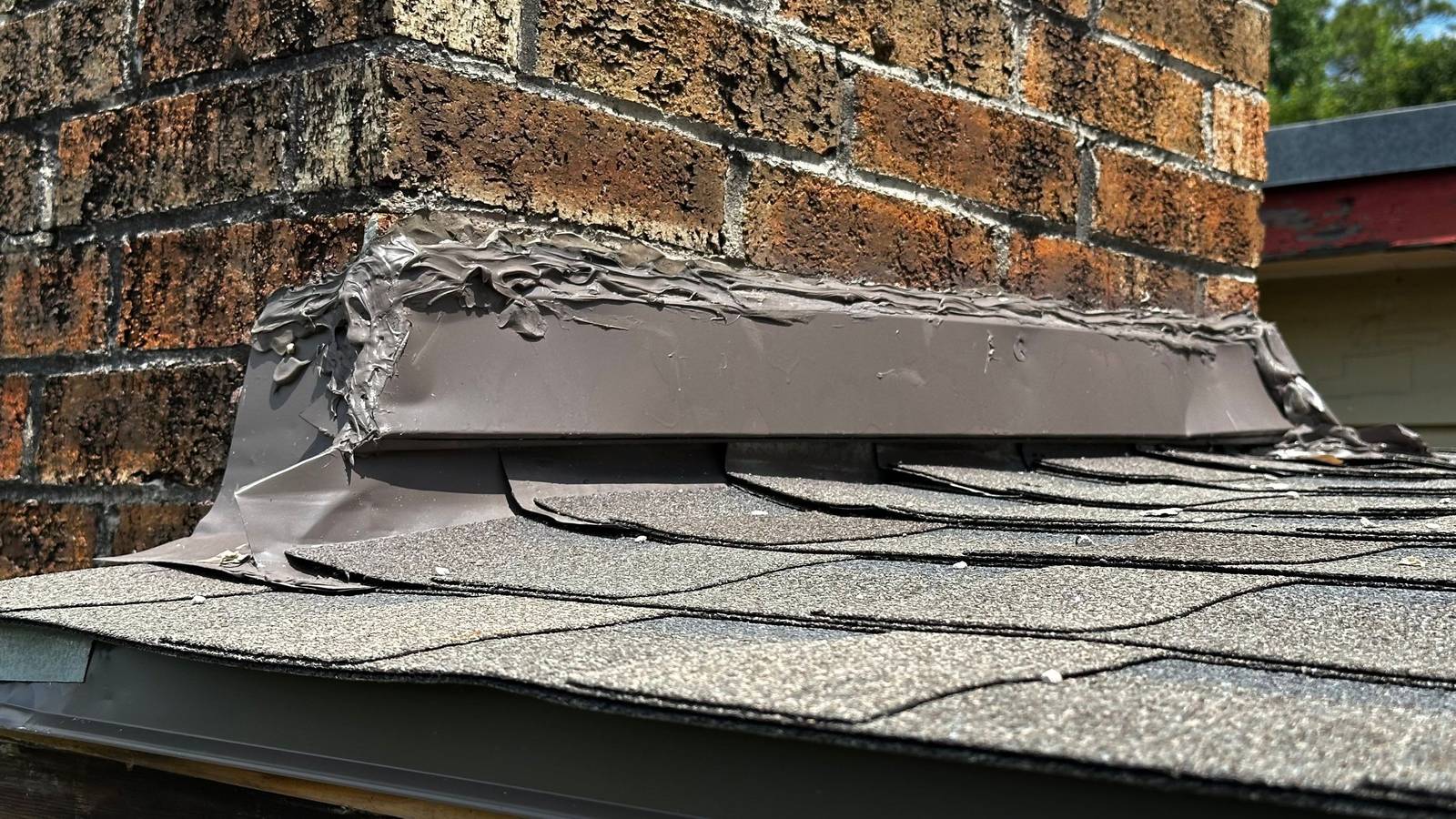
- Step and counter flashing. Step flashing is a series of L-shaped metal pieces woven into each course of shingles along the sides of the chimney. Counter flashing covers the top edge of the step flashing and is set into the mortar joints of the brick, or tucked behind the siding on a framed chimney. When either piece rusts, pulls loose, or was replaced with a bead of caulk, water runs behind it. This is the most common source we find.
- No cricket (saddle). The uphill side of a chimney catches the water running down the roof above it. A cricket is a small peaked structure behind the chimney that splits that water and sends it around the sides. Without one, water and leaves pond against the back of the chimney.
- A cracked or flat crown. The crown is the concrete or mortar cap on top of a masonry chimney. When it cracks or does not shed water past the brick, water soaks down into the chimney.
- Mortar and brick. Cracked mortar gives water a path in, and brick itself is porous, so long rains can soak through it.
- A missing or damaged cap. Without a cap, rain falls straight down the flue.
- Stucco or siding chases. Many Houston-area homes have a factory-built fireplace whose metal flue runs up through a wood-framed chase covered in stucco, siding or stone. Instead of a masonry crown, the top has a metal chase cover. If that cover rusts, the stucco cracks, or the flashing where the chase meets the roof fails, water can run down inside the framing for a long time before it shows.
The Chimney Safety Institute of America (CSIA) puts it plainly in its guide to preventing water damage: water causes more damage to masonry chimneys than fire. CSIA compares common brick to a sponge and says crowns should project beyond all sides by two inches to help prevent erosion of the brick and mortar below. Our guide to roof flashing explains step and counter flashing in more detail.
Is it a chimney leak or a roof leak?
Water rarely drips straight down from where it gets in. It can land on the decking, run along a rafter and show up several feet away, so a stain near the chimney can come from a pipe boot or valley uphill, and a chimney leak can show up across the room. These clues help narrow it down:
| Clue | Points to the chimney | Points to the roof |
|---|---|---|
| Where the water shows | Inside the firebox, on the damper, or on the wall around the fireplace | Ceiling spots away from the chimney, near vents, valleys or skylights |
| In the attic | Wet or stained wood right against the chimney framing, often on the uphill side | Stains that trace uphill to a pipe boot, valley or damaged shingles |
| Outside | Caulk smeared over flashing, a cracked crown, a missing cap, a rusted chase cover, cracked stucco, or white staining on the brick | Missing, lifted or cracked shingles, cracked pipe boots, worn valleys |
A roofer confirms the source by checking the attic, then the roof uphill of the stain, and sometimes by water-testing one section at a time, starting low and working up. Whatever the source, dry wet materials quickly: the EPA's guide to mold and moisture advises drying water-damaged areas within 24 to 48 hours to help prevent mold growth. Our guide to roof leak repair cost in Houston covers the other common leak sources.
How is a leaking chimney repaired?
Reflashing
For most flashing leaks, the lasting fix is to remove the shingles around the chimney, install new underlayment and new step flashing at each course, and install new counter flashing cut into the mortar joints or new flashing under the siding of a framed chase. Sealant has a small role, such as sealing the joint where counter flashing enters the brick, but it is not the waterproofing.
Adding a cricket
The International Residential Code calls for a cricket or saddle on the ridge side of any chimney more than 30 inches wide, measured perpendicular to the slope, covered in sheet metal or the same material as the roof. A cricket is framed behind the chimney, covered with underlayment and flashed into the chimney and the roof. It is easiest to add when the shingles around the chimney are already off.
Crown, cap, mortar and chase repair
Leaks from the top of the chimney call for different work: repairing or rebuilding the crown, installing a cap, repointing failed mortar joints, or replacing a rusted chase cover and repairing cracked stucco on a framed chase. Some of this is roofing work and some is masonry or chimney work. Ask who will do each part, and have any masonry done before new flashing and shingles go on so the new roof is not damaged afterward.
On cost, our estimator shows $450 to $1,900+ for a typical residential roof repair, and chimney flashing sits higher in that range than a simple pipe boot; larger repairs can exceed it. Masonry and chase work varies too much to quote in general, so we confirm the price after an inspection. See our roof repair page for how we diagnose leaks.
Should I fix the chimney when I replace my roof?
Yes. During a roof replacement the shingles around the chimney come off anyway, so new step flashing, counter flashing and underlayment can be installed correctly with the new roof. Reusing old chimney flashing under new shingles leaves a weak spot on an otherwise new roof, and if a cricket is needed, this is the simplest time to build it. On our roof replacements, wall and chimney flashing are part of the installation, not an afterthought. Whoever you hire, make sure chimney flashing appears as its own line on the estimate; our guide on how to read a roofing estimate shows what to look for.
What should I ask a roofer about a chimney leak?
- Where exactly is the water getting in, and can you show me photos?
- Is this a flashing leak, a crown, cap or masonry problem, or a roof leak nearby?
- Will you install new step and counter flashing, or only seal what is there?
- Does my chimney need a cricket?
- Which parts of the repair are roofing work, and which need a mason or chimney professional?
Chimney leak questions
Can I just caulk around my chimney to stop a leak?
Caulk may slow a leak for a while, but it dries out and cracks in the Houston sun and does not replace step and counter flashing. A lasting fix usually means rebuilding the metal flashing, with sealant used only where the counter flashing meets the brick.
Why is water coming into my fireplace?
Water inside the firebox or on the damper usually comes from the top of the chimney: a missing or damaged cap, a cracked crown, or a rusted chase cover on a framed chimney. Flashing leaks more often show up on the ceiling or wall beside the chimney.
Does my chimney need a cricket?
The International Residential Code calls for a cricket or saddle on the ridge side of any chimney more than 30 inches wide, measured perpendicular to the slope. Even on narrower chimneys, a roofer may recommend one if water or debris collects behind the chimney.
Water stain by the fireplace? Book a free, photo-documented inspection with no obligation, or call PL Roofing & Remodeling at 832-860-0354. We show you where the water is coming from and confirm the repair price after the inspection. Hablamos español.