In our preliminary ranges, most roof leak repairs in the Houston area run $450 to $1,900 or more, depending on what failed, how much has to be opened up, and whether wet decking must be replaced. Small, contained fixes like a pipe boot usually sit toward the low end; valleys, flashing rebuilds and rotted decking push toward the top or beyond. The final number is confirmed after an inspection.
A water stain on the ceiling rarely tells you what the repair will cost, because the stain is where the water ended up, not where it got in. Water can travel along rafters and decking for several feet before it drips. That is why a good repair price starts with finding the actual entry point. Here is what the most common repairs involve, what moves the price, and when a repair stops making sense.
What causes most roof leaks in Houston?
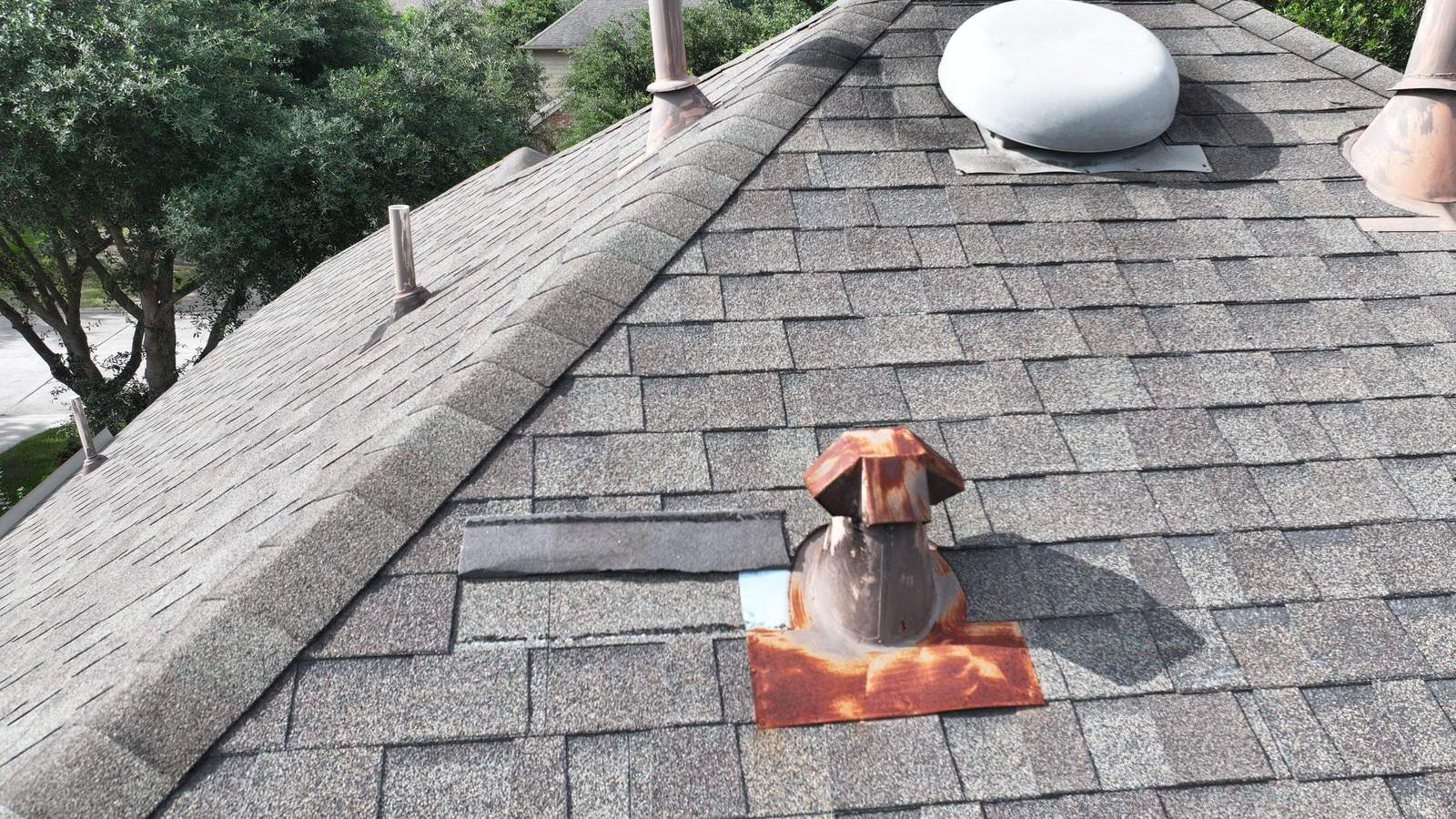
- Cracked pipe boots. The rubber collars around plumbing vents dry out and split in our sun.
- Failed flashing. Metal at walls, chimneys, skylights and dormers loosens, rusts or loses its sealant.
- Missing or lifted shingles. Wind breaks the seal strip or tears shingles off.
- Worn or clogged valleys. Valleys carry the most water on the roof and collect leaves.
- Exposed or backed-out nails. Heat cycles can push nails up through shingles.
- Gutter backup. Water pools at the edge and works under the first course of shingles.
How much do common roof repairs cost?
This guide does not list a fixed price for each repair, because two pipe boot repairs can be very different jobs. Instead, here is where common repairs tend to fall within our preliminary range of $450 to $1,900 or more. Every number is confirmed after an inspection.
| Repair | What is usually involved | Where it tends to fall in our preliminary range |
|---|---|---|
| Pipe boot replacement | Remove surrounding shingles, install a new boot, reseal and reshingle | Lower end |
| Replacing a few missing or creased shingles | Match shingles, reseal neighbors, check the underlayment | Lower end, higher if matching is hard |
| Exposed nails and small sealant repairs | Reset or replace fasteners, seal, often bundled with other repairs | Lower end |
| Wall or chimney flashing repair | Remove shingles and siding trim, replace step and counter flashing | Middle to upper end |
| Valley repair | Open the valley, replace underlayment and shingles or metal along its length | Middle to upper end |
| Wet or rotted decking | Remove shingles, cut out and replace plywood, rebuild the layers | Upper end or above, depending on area |
For comparison, a full asphalt replacement runs about $375 to $650 per roofing square (100 square feet) in our preliminary ranges. Our pricing guide explains both in more detail.
What makes a roof repair cost more?
- Hidden damage. Once shingles come up, soft or rotted decking may need replacing.
- Steep or tall roofs. More safety equipment and slower, careful work.
- Hard-to-match shingles. Discontinued colors or older lines take longer to source, and a patch may not match exactly.
- Complex details. Chimneys, skylights, dormers and wall intersections take more labor than open roof.
- Brittle shingles. On older roofs, surrounding shingles can crack when lifted, so the repair area grows.
- Interior damage. Drywall, insulation and paint are separate from the roof repair itself.
Why can't a roofer give me an exact price over the phone?
Because the entry point and the condition under the shingles are unknown until someone looks. A fair roofer can give you a preliminary range, then confirm it after inspecting the roof and, when it applies, the attic. Ask for a written estimate that names the repair, the materials and what happens if hidden decking damage is found. The Texas Department of Insurance also recommends getting more than one written bid and never signing a contract with blank spaces. Our guide to what happens during a roof inspection shows what that visit should include.
How fast should I fix a roof leak?
As soon as you can. TDI notes that mold can start growing within a day after a leak, and the EPA's guide to mold and moisture explains why fixing the water source comes first. While you wait for the repair:
- Catch the drip and move belongings away from the wet area.
- Photograph the ceiling, the attic if you can safely look, and any damage outside.
- Keep an eye on ceiling bulges and keep people away from sagging drywall.
- Do not climb onto a wet roof yourself.
Will insurance pay for a roof leak repair?
Your insurer decides that, and it depends on your policy and the cause. TDI explains that most home policies cover sudden and accidental water damage, but usually not damage from gradual leaks or seepage. A leak caused by a storm that tore off shingles is treated differently from a pipe boot that wore out over years. TDI also notes you usually must report hidden water damage within days after you first see it. If a storm caused the leak, we document it with photos, but we are a contractor, not a public adjuster, and your insurer decides any claim.
When does repairing a roof stop making sense?
- Leaks keep coming back in different places after repairs.
- Shingles crack when lifted, so each repair damages the area around it.
- Damage is spread across several slopes rather than one spot.
- The decking is soft in more than one area.
- The roof is near the end of its life and repairs would add up quickly.
A helpful way to decide is to compare cost per year: a repair that buys several good years is usually worth it, while repeated repairs on a worn-out roof often are not. Our repair-or-replace checklist walks through the decision, and our guide to the signs you need a new roof shows what end-of-life wear looks like. You can also see our roof repair page.
Roof leak repair questions
Is a roof leak repair a DIY job?
Catching the drip and moving belongings is. Working on the roof usually is not: falls are a real risk, and caulk smeared over a leak often traps water and makes the real repair bigger. If you need a temporary cover, use a professional tarp.
Why does my ceiling stain not line up with the leak?
Water often runs along rafters, decking or the top of drywall before it drips, so the stain can be several feet from where water enters. That is why checking the attic, when it applies, is part of finding the leak.
Will a patch match my existing shingles?
Often close, but not always exact, especially on older or discontinued shingles and on roofs that have faded in the sun. Ask to see the replacement shingle before the work starts.
Have a leak you want found and priced? Book a free, photo-documented inspection with no obligation, or call PL Roofing & Remodeling at 832-860-0354. We show you where the water is getting in and confirm the repair price after the inspection. Hablamos español.