The clearest signs you need a new roof in Houston are age past about 20 years, heavy granule loss, curling or cracked shingles, missing shingles on several slopes, daylight or water stains in the attic, a sagging roofline, and leaks that keep coming back after repairs. One sign alone may mean a repair; several together usually mean replacement.
Roofs rarely fail all at once. They wear down for years, and then one ordinary summer storm finds the weak spot. Our owner, Eloy Pico, has been working on Houston roofs for more than 20 years, and the pattern he sees most is a family that had plenty of warning but did not know what the warning looked like. Here is what to look for from the yard and the attic, and what not to worry about.
1. How old is too old for a roof in Houston?
Heat, humidity and strong sun are hard on asphalt. In our experience, a well-installed architectural shingle roof in the Houston area typically gives around 20 to 25 years, and 3-tab roofs usually less. That is often shorter than the number on the manufacturer's warranty, because real attics and real Texas summers are rarely ideal. If you do not know your roof's age, look at your closing paperwork, a past inspection report or permit records, or ask neighbors whose homes were built at the same time.
Age also matters for insurance. The Texas Department of Insurance notes that insurers may pay less on older or worn roofs and may change coverage at renewal as a roof ages.
2. Why are there shingle granules in my gutters?
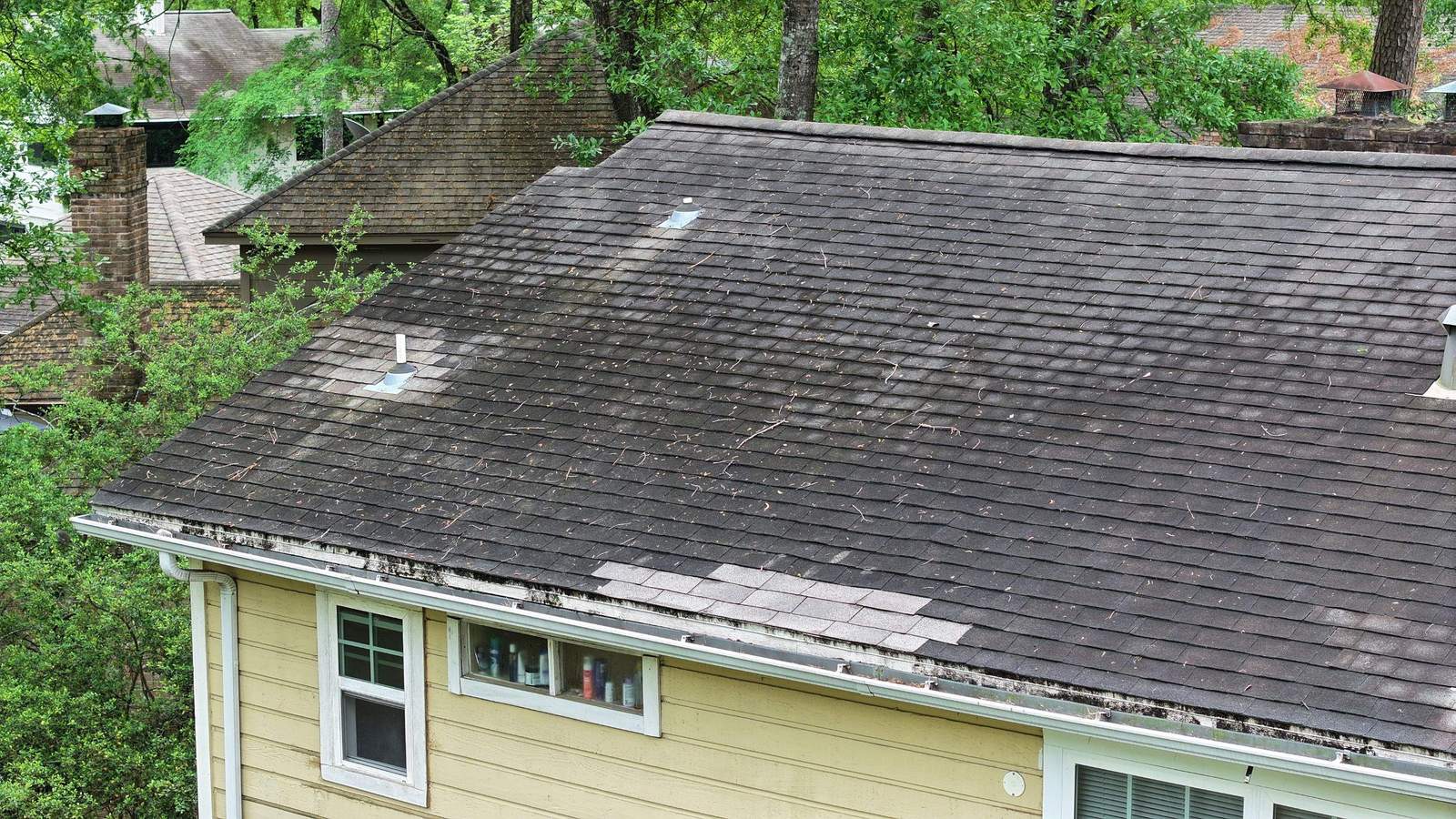
The coarse, sand-like grit on shingles protects the asphalt from sunlight. Some loose granules right after a new install are normal. A steady buildup in gutters and at downspout outlets on an older roof, or bare, smooth patches where the dark mat shows through, means the shingles are losing their protection and will age faster from here.
3. What do curling or cracked shingles mean?
Look at the roof from across the street in late afternoon, when low sun shows texture. Edges turning up (curling), centers lifting while edges stay flat (cupping), and cracks across the tabs all mean the shingles have lost flexibility. A few can be replaced. Once it is happening across whole slopes, patching becomes a cycle of paying for small fixes on a roof that is wearing out everywhere at once.
4. Are missing shingles a sign I need a new roof?
A handful blown off after a windstorm is often a repair. Missing shingles on several slopes, or new ones disappearing after every gusty afternoon, usually means the sealant strips that bond each course together have failed across the roof. At that point, new shingles next to old ones tend not to seal well either.
5. What should I look for in my attic?
This is the most useful 15 minutes a homeowner can spend. On a bright day, go into the attic with a flashlight, turn off the lights and look up. Watch for:
- Pinpoints of daylight through the decking
- Dark stains or streaks on the underside of the plywood
- Rusty nail tips, damp or matted insulation
- A musty smell, which often points to trapped moisture and poor ventilation
Step only on the framing, never on the ceiling drywall between the joists.
6. Is a sagging roof an emergency?
Sight along the ridge and the roof planes from the street. They should be straight. A dip, wave or soft-looking area usually means the decking or framing has been weakened, often by long-term moisture. Of everything on this list, sagging is the one to call about right away, not next season.
7. Why does my roof keep leaking after repairs?
A single leak at a pipe boot or chimney is usually a straightforward roof repair. When leaks keep showing up in new places, or you can see flashing that has been patched over and over with roofing tar, the roof is telling you the whole system is near the end. Each repair buys less time than the one before.
Quick reference: repair or replace?
| What you see | Usually means |
|---|---|
| Roof under 15 years, one damaged area | Repair |
| One leak at a vent, boot or chimney | Repair |
| Granule loss and curling across several slopes | Plan a replacement |
| Missing shingles on multiple slopes, repeated wind losses | Plan a replacement |
| Roof past 20 years with any of the above | Replacement is likely the better value |
| Sagging roofline or soft decking | Call now for an inspection |
What looks bad but usually isn't?
- Black streaks. Usually algae. The Asphalt Roofing Manufacturers Association notes that algae discoloration is most widespread in the Gulf States, and it warns that pressure washing is likely to damage asphalt roofing. In our experience the streaks are an appearance problem, not, by themselves, a reason to replace a roof.
- One leak around a vent or chimney. Often a flashing repair. Get a second opinion before anyone sells you a whole roof on the strength of one drip.
- Leaves and debris in the valleys. Needs cleaning and maybe tree trimming, not a new roof.
If more than one of the seven signs applies, our repair-or-replace decision checklist goes deeper, and our roof replacement page explains how a PL project runs from tear-off to closeout.
Roof replacement questions
Can I replace only part of my roof?
Sometimes, when damage is limited to one slope and matching shingles are available. On an aging roof, a partial replacement leaves the rest still wearing out, and colors rarely match perfectly. We show you both options with photos.
Do black streaks mean my roof is failing?
Usually not. Those streaks are typically algae, which mainly affects appearance. Avoid pressure washing, and ask about algae-resistant shingles when you eventually replace.
How do I know how much life my roof has left?
An inspection that photographs every slope and the attic gives you a real answer. If your roof has good years left, we will tell you that plainly.
Not sure which signs apply to your roof? Book a free, photo-documented roof inspection or call PL Roofing & Remodeling at 832-860-0354. You will see every slope, and if you have years left, we will say so. Hablamos español.